Live In-Play Basketball Betting Strategy
 Available in US
I missed a live bet by three seconds once. The spread had shifted to +14.5 on an underdog trailing by 18 in the third quarter. By the time my thumb hit the confirm button, the line had already moved to +12.5 after a quick 6-0 run. Three seconds, two points of spread value, gone. That moment crystallised something I had suspected for a while: in-play basketball betting is not just a faster version of pre-game betting. It is a different discipline entirely. Live momentum shifts are crucial, especially when you are applying a targeted quarter betting strategy to capitalize on team rotations.
Live wagering now accounts for 62.35% of global online sports betting volume and is growing at a compound annual rate of nearly 14%. Basketball, with its constant scoring, frequent stoppages, and dramatic momentum shifts, is the ideal sport for in-play markets. But the speed that makes it exciting also makes it dangerous. This guide lays out the specific live markets available for basketball, the timing patterns I use to identify entry points, the data infrastructure that powers the odds on your screen, and the discipline framework that keeps a live betting session from turning into an expensive adrenaline rush.
A word of context before we dive in: everything in this guide assumes you are betting through a UK-licensed platform. The markets, the data feeds, and the regulatory protections I reference are specific to the UK gambling ecosystem. Live basketball betting exists worldwide, but the combination of deep NBA market coverage, strong consumer protection standards, and competitive pricing that UK punters enjoy is not universal. That said, the strategic principles — reading momentum, timing entries, managing risk — are transferable to any platform and any basketball competition.
Live In-Play Markets for Basketball Betting
Next-Quarter and Next-Half Markets
While the full-game moneyline, spread, and total remain active throughout a live basketball game, the real depth of in-play betting lies in period-specific markets. Next-quarter spread, next-quarter total, and next-half outcomes are recalculated at every break in play, creating a rolling sequence of mini-markets within a single fixture.
I find next-quarter totals particularly useful because they strip away the noise of what has already happened. If the first quarter finishes 34-22, the full-game total has already been influenced by an unusually high-scoring opening period. But the second-quarter total is set fresh, based on updated pace data and current lineup information. That reset gives you a clean analytical surface — you are not inheriting the biases of a line that was set hours before tip-off.
Next-half markets offer a broader canvas. The second-half spread, for instance, is effectively a new game within a game. If the first half was dominated by one team, the second-half line will reflect that dominance — but regression to the mean is a powerful force in basketball. Teams that shoot 55% from three in the first half rarely maintain that clip. Teams that turn the ball over fifteen times before the break rarely continue at that rate. Second-half markets let you bet on the correction without needing the full-game result to swing in your favour.
Live Totals and Adjusted Spreads
The live full-game total adjusts continuously. A game that starts slowly — say, 18-15 after the first quarter — will see its total drop from the pre-game line, sometimes by five or six points. Conversely, a high-scoring first half pushes the live total upward. The key question is whether the observed pace is sustainable or an outlier. Teams that come out firing in the first quarter often cool down; teams that start cold frequently find their rhythm. Recognising the difference between a genuine pace shift and a short-term fluctuation is the core skill of live totals betting.
Adjusted spreads work similarly. A team leading by 10 at half-time might see their pre-game spread of -3.5 reflected in a live line of roughly -10.5 or -11.5, depending on how the models weigh the first-half performance. If you believe the trailing team will mount a second-half comeback — perhaps because their best player was in foul trouble and is now free to play aggressively — the live spread on the underdog offers value that did not exist before the game started.
Real-Time Player Performance Markets
This is where the NBA’s data partnerships have changed the game most dramatically. In 2024, the league granted selected operators access to optical player-tracking data, enabling markets like “next player to score”, “total points in the next two minutes”, and real-time player stat thresholds — will a player exceed 25.5 points tonight, updated live based on their current total and the remaining game time.
These micro-markets are genuinely new. Five years ago, they did not exist at UK platforms. Now they are available for most marquee NBA fixtures, and they reward a specific type of knowledge: understanding individual player tendencies within specific game contexts. A player averaging 28 points per game who has 22 with eight minutes remaining is not a guaranteed over on 25.5 — it depends on whether their team is in a blowout (starters get pulled) or a close game (every possession counts). That contextual layer is what separates profitable live prop betting from random speculation.
Reading Momentum: When to Place a Live Basketball Bet
Momentum in basketball is real, measurable, and fleeting. A 10-0 run can happen in ninety seconds. The challenge for live bettors is distinguishing between momentum that will sustain — driven by a tactical adjustment, a lineup change, or genuine defensive pressure — and momentum that is simply noise, a brief hot streak that regresses within minutes.
The integration of streaming data and live feeds into betting platforms has increased the average number of bets placed per client session by 35-45%. That statistic tells you something important about human behaviour: when people watch a game and see a big run, they bet. The question is whether that impulse aligns with value or whether it is a reaction to visual drama that the odds have already priced in.
My approach is contrarian by nature. I look for moments when the market overreacts to a momentum swing. A trailing team goes on a 12-2 run to cut a 16-point deficit to six, and the live spread shifts dramatically in their favour. But if the leading team called a timeout during that run, if their best player was resting and is about to re-enter, or if the run was fuelled by three-pointers that the trailing team hits at a below-average rate — those are signals that the momentum is likely to stall. The market, driven by the volume of reactive bettors, often overshoots in these moments. That overshoot is where I place my bets.
Timeouts are the most reliable momentum interrupter in basketball. A well-timed timeout breaks the opposing team’s rhythm, allows the coach to adjust the defensive scheme, and gives starters a brief rest. I have a personal rule: never bet into a momentum run until the losing team has used a timeout. If the run continues after the timeout, the momentum is more likely to be real. If the run stalls, the pre-timeout line was closer to fair value, and the current line is an overshoot.
Foul trouble is another momentum signal the market consistently underweights. When a key player picks up their fourth foul in the third quarter, they typically sit for an extended stretch. The live odds adjust for their absence, but they often under-adjust for the tactical ripple effects — the backup player’s defensive limitations, the change in offensive spacing, the shift in rebounding dynamics. I have built some of my best live positions around foul-trouble scenarios, particularly when the player in question is a defensive anchor whose absence opens up driving lanes for the opposing team’s guards.
The fourth quarter deserves special attention. With five or six minutes remaining in a close game, the NBA’s intentional fouling strategy kicks in — trailing teams deliberately foul to stop the clock, sending the leading team to the free-throw line. This creates a predictable scoring pattern (free throws rather than field goals) that affects both the live total and the live spread in specific, modelable ways. If you understand the fouling endgame, you can anticipate odds movements rather than reacting to them.
How Real-Time Data Feeds Power Live Basketball Odds
The NBA’s billion-dollar deal with Sportradar is not just a commercial arrangement — it is the infrastructure layer that makes live basketball betting possible at the speed and depth we see in 2026. Sportradar captures play-by-play data from every NBA game, processes it in near-real-time, and distributes it to licensed operators worldwide. That data feed is what allows the spread to update within seconds of a three-pointer, and it is what powers the micro-markets I described above.
Scott Kaufman-Ross, the NBA’s SVP of Gaming and New Business Ventures, has described the partnership between the league, data providers, and betting operators as a convergence of media and sports wagering. For UK punters, the practical implication is that the odds you see on a live NBA game at a London-facing platform are generated from the same data feed that powers the odds in Las Vegas. The playing field, in terms of data access, is level. What differs is the speed at which individual platforms process and display that data — and that processing speed is a genuine competitive factor when you are betting in-play.
One wrinkle worth understanding: the data feed has a built-in latency. There is a delay — typically one to three seconds — between an event occurring on the court and the corresponding odds update appearing on your screen. Operators build in this delay deliberately, partly for technical reasons and partly to protect themselves from bettors who might exploit real-time television feeds that run slightly ahead of the data pipeline. That latency is not something you can eliminate, but being aware of it prevents you from over-interpreting momentary odds freezes as signals.
The quality of the data feed also varies by game. High-profile fixtures — nationally televised games, playoff matchups, Christmas Day specials — tend to have the fastest and most granular data processing. A mid-week regular-season game between two small-market teams might see slightly slower updates and a narrower range of live micro-markets. This is not a conspiracy; it is a resource allocation decision by the data providers. For UK punters, the practical takeaway is that your live betting edge is largest on the games that attract the most data coverage, which are also the games you are most likely to be watching.
I should note that the data infrastructure powering live basketball odds is the same infrastructure that enables the player-tracking micro-markets I mentioned earlier. The “next player to score” market, for instance, requires the system to know which players are currently on the court, their scoring rates, and the game context — all updated in real time. Without Sportradar’s optical tracking layer, these markets would be impossible to price accurately. The technology is the product, and understanding that gives you a clearer picture of why live basketball betting has evolved so rapidly compared to sports where the data infrastructure is less developed.
Mobile Betting and In-Play: the Speed Advantage
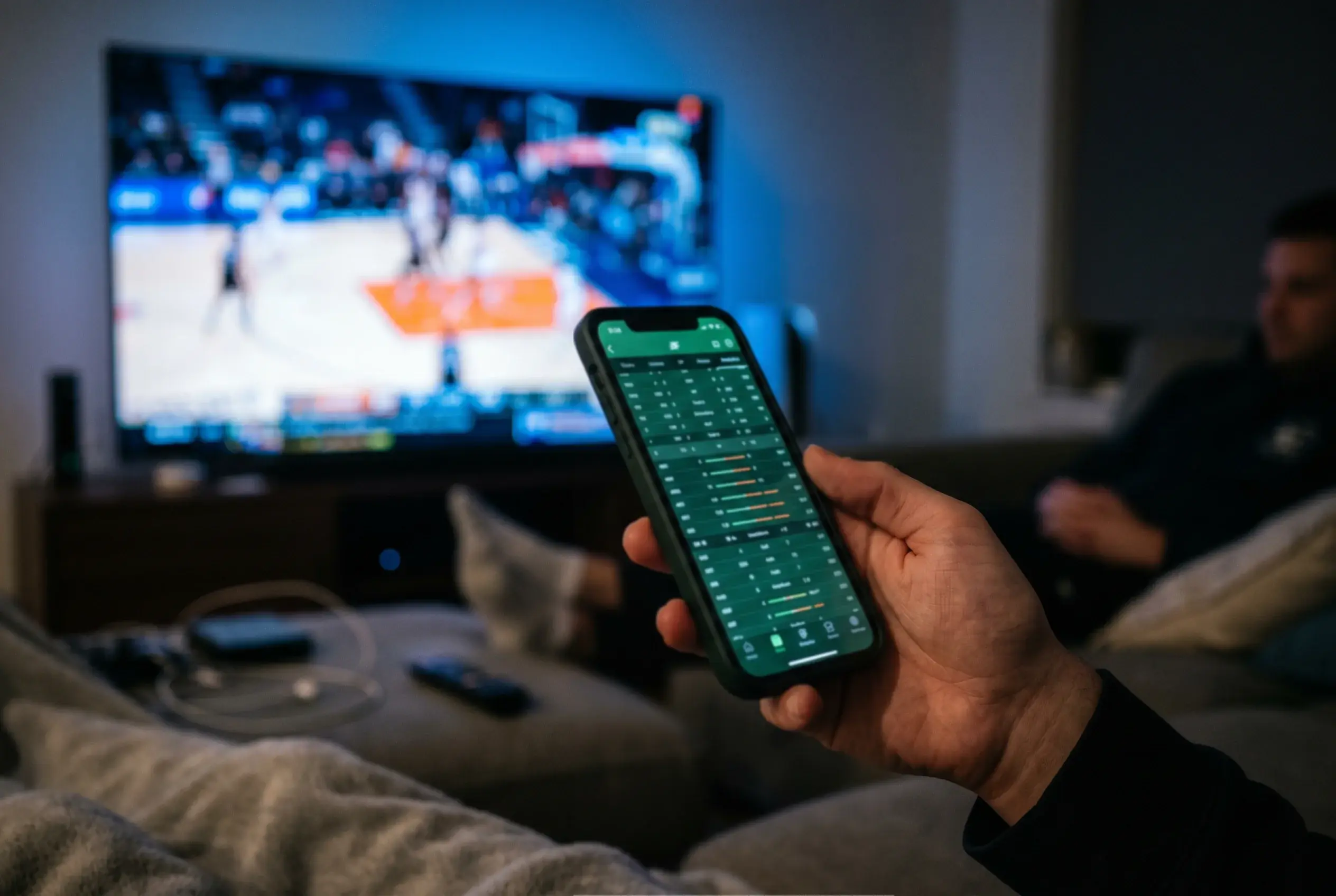
Around 80% of online gamblers used smartphones for betting in 2025, and for live basketball, the phone is not just a convenience — it is the primary tool. The combination of watching a game (whether on television, a stream, or even a bookmaker’s own live feed) and placing bets on the same device creates a seamless loop that desktop simply cannot match for speed and accessibility.
But speed has a dark side. The ease of tapping a bet on your phone while watching a dramatic fourth-quarter collapse is precisely what makes mobile live betting psychologically treacherous. There is no friction between impulse and action. On a desktop, the physical act of switching windows, typing a stake, and clicking a button introduces a micro-delay that sometimes — not always, but sometimes — gives you a moment to reconsider. On a phone, the gap between seeing an opportunity and committing money is measured in milliseconds.
I have two rules for mobile live betting that have saved me significant money over the years. First, I set my default stake before the game starts and do not change it during live play. The temptation to increase your stake after a losing bet — to chase — is strongest on mobile because the adjustment is so easy. A fixed default removes that temptation. Second, I keep a simple notepad app open alongside the betting app. Before I place a live bet, I type a one-line reason: “Live under 215.5 because pace dropped to 94 after Q2.” If I cannot articulate a reason in one sentence, I do not bet. That rule alone has probably eliminated half of my worst live betting decisions.
Connectivity is a practical concern that gets overlooked. A dropped signal during a live basketball bet can mean the difference between getting the price you want and missing the market entirely — or worse, having a bet placed at odds you did not intend. If you are betting live on NBA games from a UK mobile network at two in the morning, make sure you are on a stable Wi-Fi connection. I have lost count of the number of times a brief mobile signal drop has cost me a position I was confident about. Treat your internet connection as part of your betting infrastructure, not an afterthought.
Bankroll Discipline During Live Basketball Sessions
Roughly 450 million people worldwide experience some form of gambling-related harm, and approximately 80 million meet the clinical threshold for a gambling disorder. Those are not statistics I include for decoration. Live basketball betting, with its speed, its emotional intensity, and its continuous availability across a full NBA season, carries genuine risk for anyone who does not approach it with structured discipline.
My bankroll framework for live sessions is simple and non-negotiable. I allocate a fixed percentage of my total basketball bankroll to live betting each week — never more than 20%. Within that allocation, no single live bet exceeds 2% of the weekly live bankroll. If I hit my weekly loss limit, I stop. No exceptions. If I hit a target profit threshold — typically 15% of the weekly allocation — I also stop, because continuing to bet after a profitable run invites overconfidence.
Session management matters more in live betting than in any other format. An NBA game lasts roughly two and a half hours, and a punter watching live might see twenty or more opportunities that feel like bets. The discipline is not in identifying opportunities — they are everywhere. The discipline is in selecting only the two or three that genuinely meet your criteria and letting the rest pass. Every bet you do not place is a bet that cannot lose.
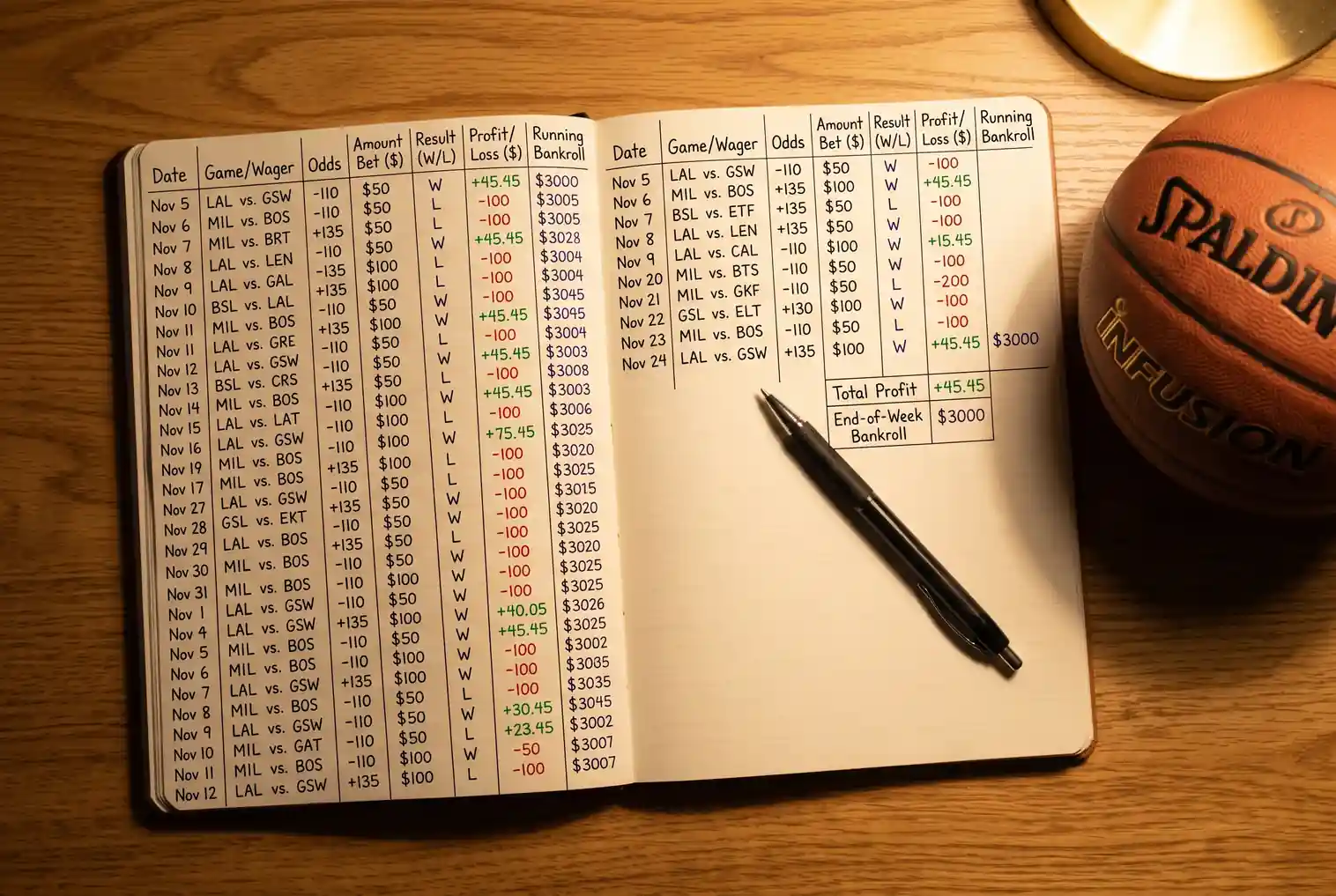
I also track a metric I call “phantom bets” — opportunities I identified and wrote down but deliberately chose not to act on. At the end of each month, I review how those phantom bets would have performed. The exercise serves two purposes: it confirms whether my criteria are filtering out noise (if the phantom bets lose more often than my actual bets, the filter is working), and it identifies patterns I might be missing (if certain types of phantom bets consistently win, I need to reassess my criteria). This kind of reflective practice is tedious, but it is what separates recreational live bettors from those who treat it as a serious analytical pursuit.
If you find that your live betting sessions consistently exceed your planned time or stake limits, that is worth taking seriously. The same-game parlay format can be a useful structural constraint — it forces you to commit to a single multi-leg bet before tip-off rather than chasing individual in-play positions throughout the game. It is not a perfect substitute for self-discipline, but it introduces a natural stopping point that open-ended live betting does not have. Stay updated with real-time odds and expert insights on our top UK basketball betting site.
Frequently Asked Questions
How fast do basketball live odds change compared to football?
Basketball live odds change significantly faster than football. In a typical NBA game, the spread and total can adjust on every possession — roughly every 20-30 seconds of game action. Football odds might update every few minutes unless a goal or red card occurs. The difference stems from basketball’s much higher scoring frequency, which means new information enters the model continuously rather than in rare, high-impact events.
What is the best quarter to place an in-play basketball bet?
There is no single best quarter, but the third quarter often presents the widest range of opportunities. Teams adjust tactics at half-time, and the market sometimes lags behind those adjustments. First-quarter live bets carry the most uncertainty because the sample of in-game data is smallest. Fourth-quarter bets are sharpest because the market has a near-complete picture by that point.
Do UK bookmakers offer live streaming for NBA games alongside in-play betting?
Several UK-licensed bookmakers offer live streaming for selected NBA games, typically requiring a funded account or a recently placed bet. Coverage varies by platform and by game — marquee fixtures are more commonly streamed than mid-week regular-season games. The stream usually runs with a slight delay relative to the actual game, which means the odds on screen may reflect events you have not yet seen.
Can I cash out a live basketball bet mid-game?
Most UK platforms offer a cash-out option on live basketball bets, including single bets and accumulators. The cash-out value fluctuates in real time based on the current game state and odds. Be aware that the cash-out price always includes a margin for the bookmaker, so the offered amount will be less than the theoretical value of your position. Cash-out availability may also be temporarily suspended during fast-moving game moments.
Prepared by the Basketball Betting Markets editorial staff.