UK Basketball Betting Markets 2026
 Available in US
By Basketball Betting Analyst
Data-Driven Betting Analysis

- The Changing Face of British Sports Wagering
- What Every UK Basketball Bettor Should Know First
- How Large Is the Basketball Betting Market in 2026?
- How Basketball Betting Odds Work in the UK
- Core Basketball Betting Markets Available to UK Punters
- Advanced Markets: Props, Futures, and Same-Game Parlays
- In-Play Basketball Betting: the 62% Market Segment
- Which Basketball Leagues Can You Bet on From the UK?
- UKGC Regulation and the 2025 Statutory Levy
- Who Bets on Basketball in the UK? Demographic Snapshot
- Betting Integrity: NBA Scandals and What They Mean for UK Markets
- Responsible Basketball Betting: Tools and UK Support
- Frequently Asked Questions
The Changing Face of British Sports Wagering
UK basketball betting markets have quietly grown into one of the most dynamic segments of the British sports wagering landscape. When I started analysing basketball odds eight years ago, the average UK punter saw the sport as a niche curiosity — something Americans watched at odd hours. That perception has shifted dramatically. The global basketball betting market reached an estimated $10 billion in 2024 and is projected to climb to $17.45 billion by 2032, driven by NBA media deals, real-time data feeds, and a generation of bettors who grew up watching LeBron James highlights on their phones.
For context, the UK gambling industry generated GGY of £16.8 billion in the year to March 2025 — a 7.3% increase year on year. Online betting, casino, and bingo accounted for £7.8 billion of that figure. Basketball occupies a growing slice of that pie, though you would struggle to find a single competitor in the top ten search results who bothers to quantify exactly how large that slice is. That gap is precisely why this guide exists.
What follows is not a list of bookmakers with sign-up codes. I have spent months pulling together market data, regulatory filings, demographic research, and integrity reports to deliver something the UK betting media consistently misses: a clear, numbers-first picture of how basketball betting actually works in this country. From point spreads and in-play markets to the UKGC’s statutory levy and NBA integrity scandals, every claim is grounded in verifiable data.
Whether you are placing your first NBA moneyline bet or trying to understand why same-game parlays generate such high margins for operators, this guide covers the full spectrum — structured to work as both a reference document and a sequential read.
What Every UK Basketball Bettor Should Know First
- The global basketball betting market hit $10 billion in 2024 and is on track for $17.45 billion by 2032 — basketball is the second most wagered-upon sport worldwide, accounting for 15-18% of global betting activity.
- Live in-play wagering now represents 62.35% of online sports betting volume and is growing at a CAGR of 13.62%, making it the dominant mode of basketball betting, not a secondary feature.
- The UKGC’s statutory levy (1.1% of online GGY from April 2025) and the Remote Gaming Duty increase from 21% to 40% (April 2026) will reshape operator economics — expect potential margin adjustments on lower-volume sports including basketball.
- UK basketball markets extend beyond the NBA: EuroLeague, British domestic leagues (SLB, BCB, NBL), and FIBA tournaments offer less efficient markets where informed bettors can find edges.
- Integrity matters. Recent NBA scandals involving player props are directly relevant to the types of bets available to UK punters — understanding the risks makes you a sharper bettor.
How Large Is the Basketball Betting Market in 2026?
Three years ago, a fellow analyst asked me to estimate what percentage of UK sports betting handle came from basketball. I could not find a single publicly available breakdown. Neither could he. The major operators do not publish sport-by-sport revenue splits, and the UKGC reports aggregate figures without distinguishing between football, tennis, basketball, or anything else. So I started piecing together a picture from global market reports, US state-level data, and operator disclosures — and the numbers are far more impressive than the industry gives basketball credit for.
Global Sports Betting Market
$124.88 billion in 2026, projected to reach $325.71 billion by 2035 at a CAGR of 11.24%
Global Basketball Betting Market
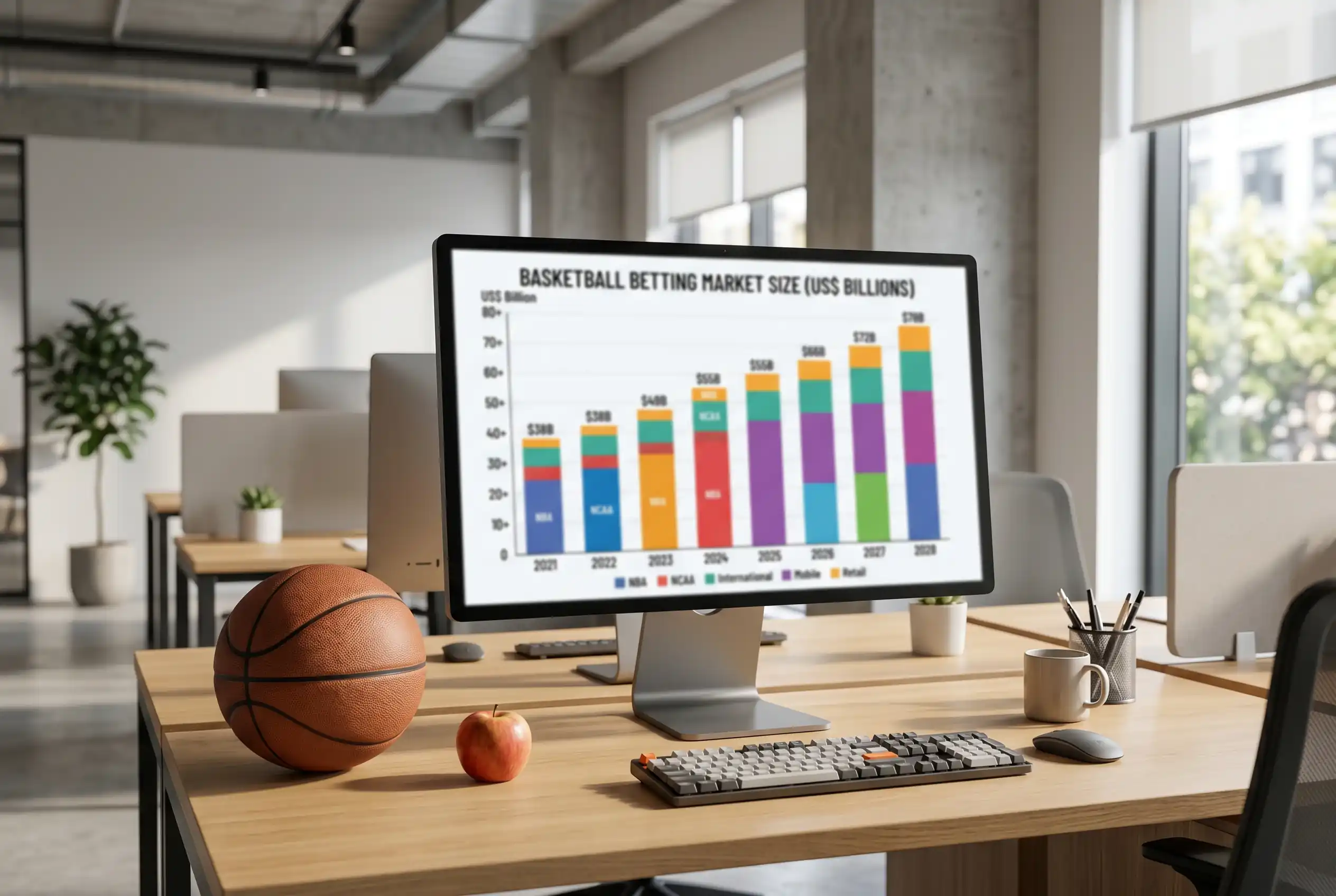
$10 billion in 2024, projected to reach $17.45 billion by 2032 at a CAGR of 7%
UK Online GGY
£7.8 billion for 2024-2025, representing 46% of total UK gambling revenue
UK Global Ranking
Third worldwide by total gambling revenue at $27 billion in 2025, behind only the US and India

The numbers tell the story clearly. Football leads globally at roughly 35% of all wagering activity, but basketball consistently ranks second, accounting for an estimated 15-18% of global betting volume. In the United States, that share climbs higher — basketball represented 28% of total handle in 2024, driven by the NBA and college basketball combined.
The UK sits third in the world for total gambling revenue, generating $27 billion in 2025. The online segment — where virtually all basketball betting occurs — produced £7.8 billion in GGY for the 2024-2025 financial year, growing by more than £900 million year on year. Basketball is riding that digital wave harder than most sports.
Basketball’s Share of Global Wagering Activity
Pinning down basketball’s exact share requires triangulating data sources. At the global level, basketball represents roughly 10% of all wagering activity, though some datasets push that to 18% depending on methodology and whether college basketball is included. If you only count NBA, the share sits around 10-12%. Add college basketball, European leagues, and FIBA tournaments, and you approach the higher end.
Basketball accounts for 15-18% of global betting activity — making it the second most wagered-upon sport after football. In the US alone, basketball generated 28% of total betting handle in 2024.
What makes these figures significant for UK bettors is the convergence of two trends. First, NBA content is more accessible in Britain than at any point in history — league pass subscriptions, social media highlights, and late-night broadcasts have built a genuine UK fan base. Second, UK-licensed operators have responded by expanding their basketball market coverage, offering everything from basic moneyline bets to micro-markets like “next player to score” during live games. The market is not just growing in absolute terms; the variety and depth of what you can bet on has expanded dramatically.
How Basketball Betting Odds Work in the UK
I once watched a friend stare at a basketball betting slip for five minutes because he could not figure out whether 1.91 was a good price. He was used to football odds in fractional format — 5/1, 7/2, evens — and the decimal numbers on the NBA screen meant nothing to him. That confusion is more common than you might expect, and it costs people money before they even place a bet.
Most UK bookmakers default to fractional odds for domestic sports but switch to decimal for basketball and other international markets. Both formats express the same information — the implied probability of an outcome and the payout you receive if your bet wins — but they do it differently. Understanding the mechanics is not optional; it is the foundation everything else in this guide rests on.
Decimal Odds
Displayed as a single number (e.g. 1.91). Multiply your stake by the decimal to calculate total return including your original stake. A £10 bet at 1.91 returns £19.10 total — your £10 stake plus £9.10 profit.
Fractional Odds
Displayed as a fraction (e.g. 10/11). The first number is your potential profit relative to the second number as your stake. A £11 bet at 10/11 returns £21 total — your £11 stake plus £10 profit.
The decimal format has a practical advantage for basketball: quick mental arithmetic. When scanning six NBA games before tip-off or comparing prices across platforms, multiplying stake by odds in one step saves time. Most experienced basketball bettors I know keep their accounts set to decimal regardless of what they use for football or racing.
Implied probability — the percentage chance of an outcome that the odds represent. Calculate it by dividing 1 by the decimal odds and multiplying by 100. Odds of 1.91 imply a 52.4% chance. Odds of 2.10 imply a 47.6% chance.
Overround — the bookmaker’s built-in margin. If both sides of a two-way basketball market have implied probabilities that sum to more than 100%, the excess is the overround. A market priced at 1.91 / 1.91 has implied probabilities of 52.4% + 52.4% = 104.8%, giving the bookmaker a 4.8% margin.
Example: NBA game, decimal odds
Team A to win: 1.74 (implied probability 57.5%)
Team B to win: 2.15 (implied probability 46.5%)
Combined implied probability: 104.0% — the 4.0% overround is the bookmaker’s theoretical edge.
A £20 bet on Team B at 2.15: total return = £20 x 2.15 = £43.00 (profit: £23.00)
The overround varies significantly between operators and between sports. Basketball markets in the UK tend to carry slightly higher margins than football because the betting volume is lower and operators price in more uncertainty. Comparing odds across multiple platforms before committing is worth the extra minute — especially on NBA prop markets, where overrounds can exceed 8%.
Core Basketball Betting Markets Available to UK Punters
Every basketball betting market I have ever analysed falls into one of two categories: markets where you predict what happens, and markets where you predict by how much. That distinction sounds simple, but it changes your entire approach to research, bankroll allocation, and risk management. The three core markets below form the foundation of basketball wagering in the UK, and they account for the majority of handle on any given NBA game night.
Moneyline
Pick the winner. No spread, no margin of victory. The simplest basketball bet available — and often the most misunderstood in terms of value.
Point Spread
A handicap applied to level the playing field. The favourite must win by more than the spread; the underdog can lose by less than the spread and still “cover.”
Totals (Over/Under)
Bet on whether the combined score of both teams will finish over or under a set line. Independent of which team wins.
Moneyline (Match Result)
The moneyline is the entry point for most UK basketball bettors. You pick a team to win the game outright. No spread, no complications. If your team wins by one point or fifty, the result is the same — your bet settles as a winner.
Where it gets interesting is in how moneyline odds reflect competitive gaps. In a close NBA matchup, you might see odds of 1.87 / 1.97 — nearly a coin flip. In a lopsided game, the favourite could sit at 1.12 while the underdog trades at 6.50. Heavy favourites at 1.10-1.15 look safe until you calculate how many you need to string together for meaningful profit — one upset wipes out a dozen wins.
For UK punters used to football’s three-way market (home, draw, away), basketball’s moneyline is cleaner. There is no draw. Regular-time ties go to overtime, and overtime always counts for moneyline settlement. That binary outcome makes probability modelling more straightforward than in any sport with a draw option.
Point Spread (Handicap)
The spread is where basketball betting truly differentiates itself from football wagering. If an NBA team is favoured by 6.5 points, that team starts the game at -6.5 for betting purposes. They need to win by 7 or more for a spread bet to pay out. The underdog, at +6.5, can lose the actual game by 6 points and still cover the spread.
UK bookmakers typically label this as “handicap” betting, which can cause confusion for bettors familiar with the term from football’s Asian handicap markets. The mechanics are functionally identical: a numerical adjustment to the final score creating a roughly 50/50 proposition. Spread markets on NBA games are usually priced around 1.90-1.95 on each side, with the margin baked into the price rather than the line.
Half-point spreads (like -6.5 rather than -6) exist to eliminate pushes — ties against the spread. Bookmakers prefer them because they guarantee a result. The deeper mechanics of how spreads are set and how to identify value are covered in the dedicated point spread explainer.
Totals (Over/Under)
Totals betting strips away the question of which team wins and focuses entirely on scoring volume. The bookmaker sets a line — say 224.5 for an NBA game — and you bet on whether the combined final score lands over or under that number. It is a market that rewards understanding of pace, defensive efficiency, and situational factors like rest days and travel schedules.
What I find appealing about totals is that they force a different analytical lens. Instead of evaluating which team is better, you evaluate how both teams play together. A matchup between two elite defensive squads might warrant an under even if the total is already low. Two high-pace offence-first teams in transition might justify an over even at an elevated line. The variables differ from moneyline and spread analysis, making totals a useful diversification tool within a basketball betting portfolio.
These three markets — moneyline, spread, and totals — are available at virtually every UK-licensed operator for every NBA game. But they represent only the starting point. The next layer of basketball betting involves markets that did not exist five years ago, markets built on real-time data feeds and player-level statistical granularity.
Advanced Markets: Props, Futures, and Same-Game Parlays
The first time I placed a player prop bet on basketball — an over on assists for a point guard I had been tracking all season — it felt like a completely different sport from moneyline wagering. Props, futures, and same-game parlays represent the faster-growing edge of basketball betting, and they demand a different analytical toolkit. They are also where operators generate some of their highest margins, which is information worth keeping in your head every time you build a bet slip.
Player Props Overview
Player proposition bets allow you to wager on individual statistical outputs within a game. Points scored, rebounds grabbed, assists dished, three-pointers made, steals, blocks — if it appears in a box score, there is probably a prop market for it at a UK platform. The NBA’s partnership with data providers has enabled even more granular options: combinations like “points + rebounds + assists” or niche lines such as “first player to score.”
Props appeal to bettors who follow specific players closely, and they reward a type of knowledge that moneyline analysis does not tap into. Knowing that a particular centre averages 11 rebounds per game is basic; knowing that his rebound rate jumps to 14.2 against teams that play small lineups — that is where prop betting edges emerge. The full breakdown of how to research, analyse, and identify value in player prop markets is in the NBA player props strategy guide.
Futures and Outright Markets
Futures are long-range bets on outcomes that will not be decided for weeks or months. NBA championship winner, conference champion, division winner, MVP, Rookie of the Year — these markets open before the season and adjust continuously as games are played and the picture clarifies.
The appeal of futures is the price. Before the season starts, an eventual champion might be available at 15.00 or 20.00 — odds that collapse to 2.50 or lower by the playoffs. Locking in early is the theoretical advantage. The practical challenge is capital commitment: your money is tied up for months with no guarantee the market moves in your favour.
UK-licensed operators typically offer NBA futures year-round, though depth varies. Championship and MVP odds are nearly universal; division and conference winners are common but not guaranteed at every platform. Award markets beyond MVP — Defensive Player of the Year, Sixth Man, Most Improved — appear at some operators but not others.
Same-Game Parlays and Bet Builders
Same-game parlays — often branded as “bet builders” at UK operators — let you combine multiple selections from a single game into one bet. You might combine a team to win, the total to go over, and a player to score more than 25 points, all in the same NBA game. The legs multiply together, producing higher potential returns than any single bet.
Same-game parlays have become a key driver of revenue growth for operators across North America and Europe. The correlation between legs — the statistical relationship that means outcomes within the same game are not truly independent — allows bookmakers to build in higher margins than on standard accumulators where each leg comes from a different event. A player who scores heavily, for example, is more likely to be on the winning team, which means combining “player over 25 points” with “team to win” is not a pure multiplication of independent probabilities. Operators price this correlation into the payout, and the resulting margin is typically higher than on any individual leg.
Prop bet — a wager on a specific statistical outcome within a game, usually tied to an individual player’s performance rather than the match result.
Futures — a bet on an outcome that will be determined at a future date, such as a championship winner or season MVP.
Parlay (accumulator) — a single bet that combines multiple selections. All selections must win for the bet to pay out. A same-game parlay restricts all legs to a single event.
In-Play Basketball Betting: the 62% Market Segment
Here is a number that reshaped how I think about basketball wagering: live in-play betting accounted for 62.35% of the entire online sports betting market in 2025, and it is growing at a compound annual rate of 13.62%. That is not a niche within a niche — it is the majority of the market. If you are only betting on basketball before tip-off, you are ignoring the arena where most of the action happens.
Basketball is uniquely suited to in-play betting. The sport’s scoring cadence — points are scored every 30-40 seconds on average in the NBA — means that odds shift constantly. A team trailing by 12 at half-time in football is in serious trouble; a team trailing by 12 at half-time in basketball can erase that deficit in three minutes of hot shooting. That volatility creates continuous opportunities for bettors who understand momentum, rotation patterns, and pace.
In-Play Market Share
62.35% of online sports betting volume in 2025
Growth Rate
CAGR of 13.62% through 2031
Session Impact
Real-time data integration increased average bets per session by 35-45%
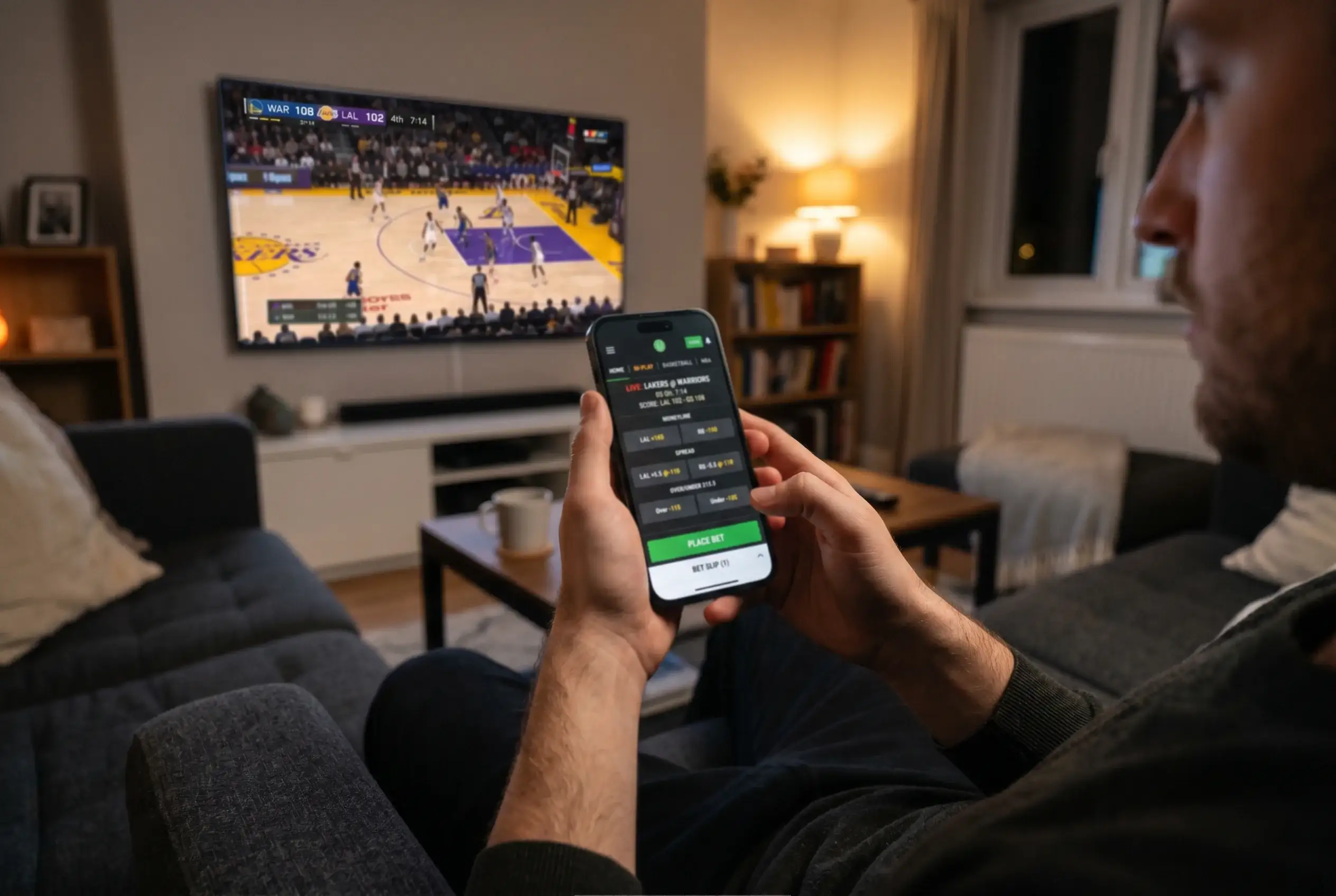
The integration of real-time data streams into betting platforms has turbocharged in-play markets. When operators incorporated live data feeds and streaming, the average number of bets per customer session increased by 35-45%. Markets like “next team to score,” “total points in the next two minutes,” and live-adjusted spreads depend entirely on second-by-second data flowing from court sensors through data providers to your betting app. Around 80% of online bettors used smartphones for wagering in 2025, and in-play basketball is a category designed for mobile — you watch on one screen, the odds update on the other.
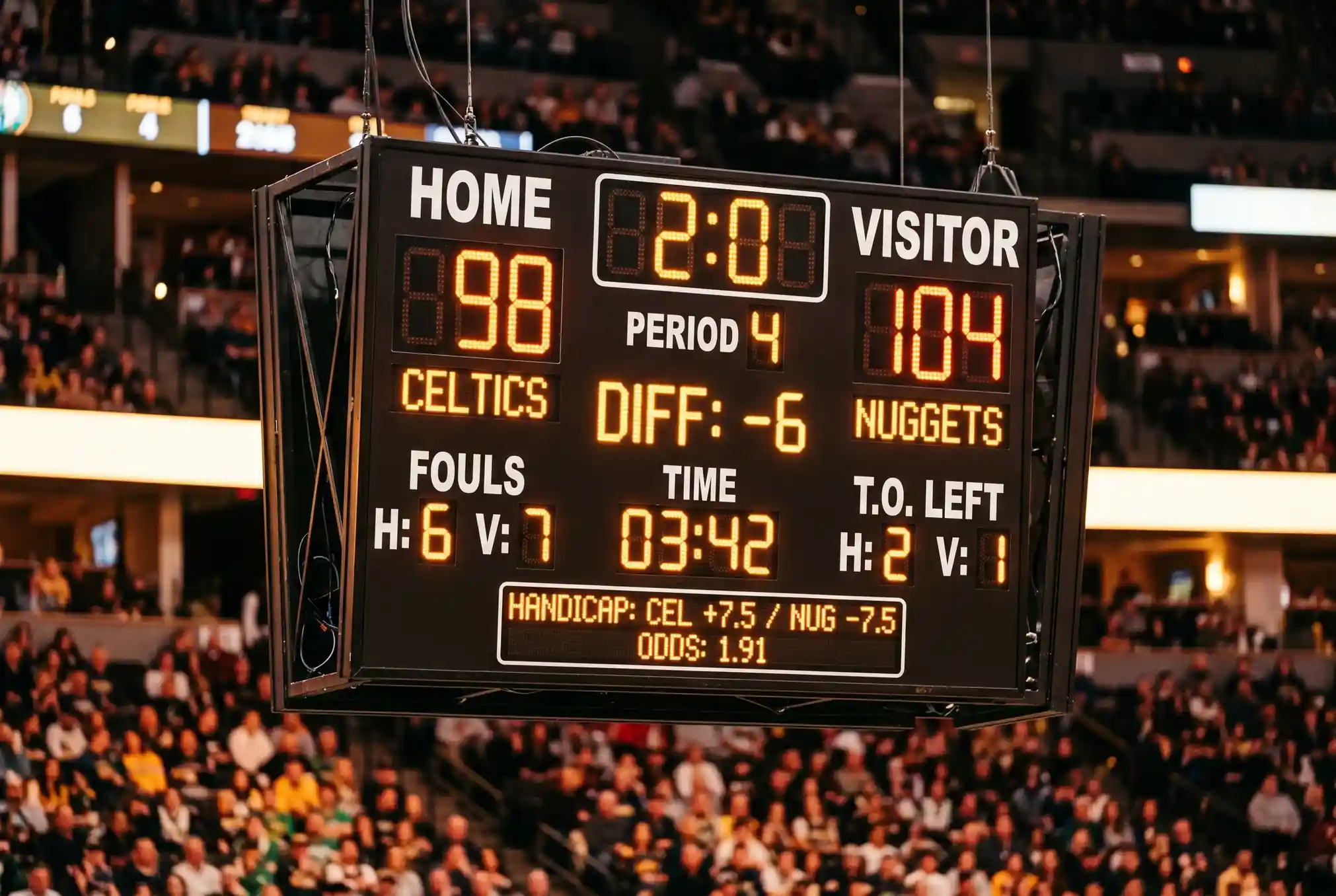
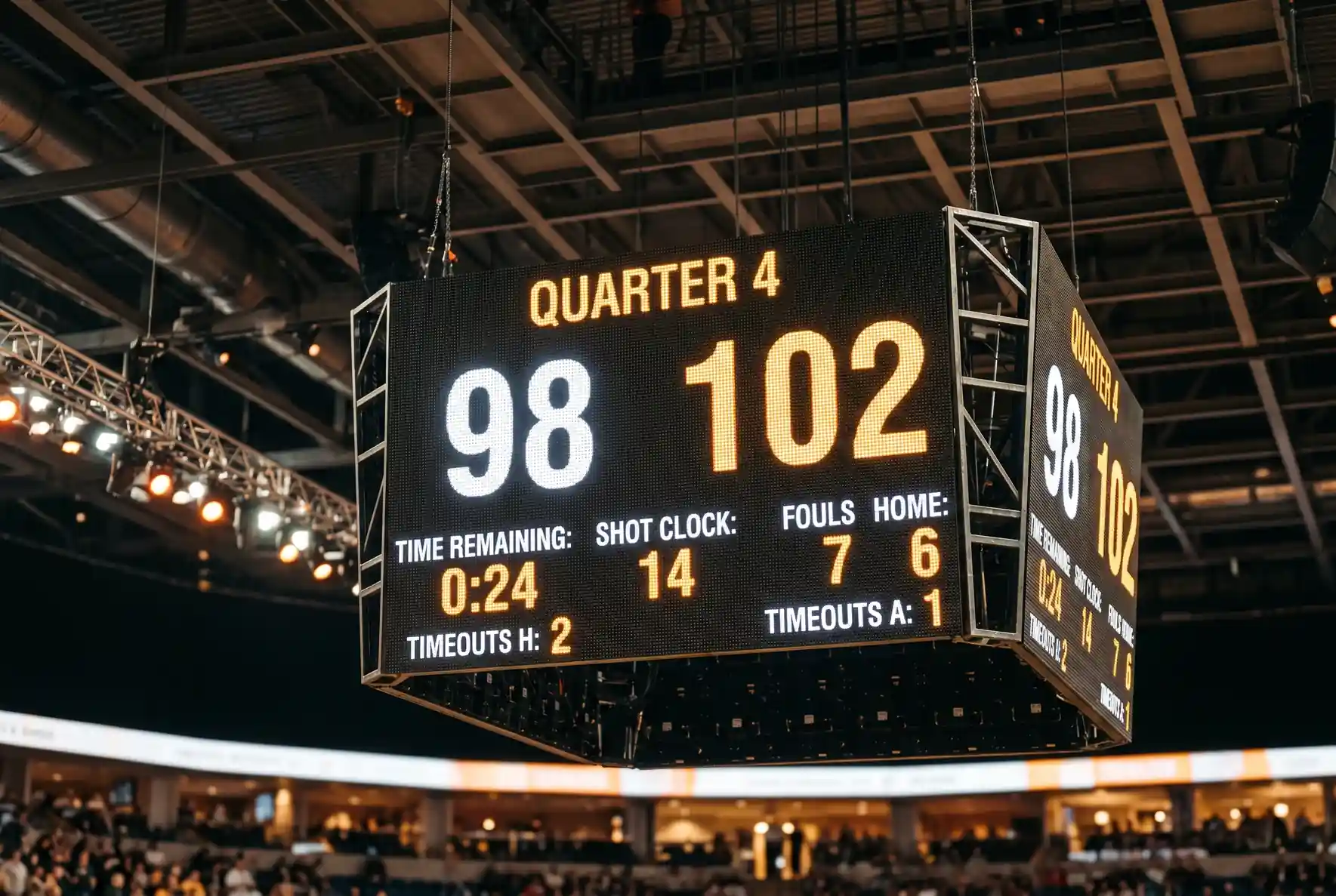
A twelve-point lead means something very different with twenty minutes left than with two. Enter the scoreboard, the clock and the pre-game line, and the model returns the live win probability, the fair live price, the fair live handicap and a projected final total — then checks them against the number your app is showing.
How it works. The points still to be scored behave like a random walk: the spread of possible outcomes shrinks with the square root of the time remaining, so a lead that is fragile at half-time becomes close to decisive by the final few minutes. The model takes a full-game margin deviation near thirteen points, scales it to the clock, adds the share of the pre-game handicap that has yet to play out, and converts the result into a probability. The projected total simply extends the pre-game scoring rate across the minutes that remain. More in the guides to in-play strategy and point spreads.
Estimates only. The model cannot see foul trouble, an injury, a hot shooter or a coach emptying the bench, and live markets suspend without warning. 18+ — please gamble responsibly. Free, confidential support at BeGambleAware.
The strategic dimensions of live basketball betting — when to bet during a game, how to read momentum shifts, how to manage bankroll during fast-moving sessions — are covered in the in-play basketball betting strategy guide. What matters here is the scale: this is where the majority of basketball betting money moves, and understanding the market dynamics is essential whether you participate in live wagering or not.
Which Basketball Leagues Can You Bet on From the UK?
A colleague once told me that basketball betting in the UK begins and ends with the NBA. He was wrong — but only just. The NBA dominates the market so completely that everything else feels like a footnote. That said, the footnotes are worth reading, especially if you are looking for less efficient markets where information advantages are easier to find.
NBA
The dominant market. Full coverage at all UK operators — moneyline, spread, totals, props, futures, and live markets for every regular-season and playoff game.
EuroLeague
Europe's elite club competition. Good coverage for game-level markets. Props and live betting available but less deep than NBA.
SLB / BCB / NBL
British domestic basketball. Limited but growing coverage. Moneyline and basic totals at select operators.
FIBA / International
World Cup, Olympics, continental championships. Seasonal coverage that peaks during major tournaments.

NBA — the Dominant Market
The NBA market is valued at $13.92 billion in 2026, with projections reaching $20.04 billion by 2031. That is not just a sports figure — it reflects media rights, merchandise, gaming partnerships, and the betting ecosystem that has grown around the league. For UK bettors, the practical implication is comprehensive coverage. Every regular-season game, every playoff matchup, and every Finals game carries a full menu of markets at UK-licensed platforms.
The depth extends beyond game-level bets. NBA futures — championship, conference, division, MVP, and other awards — are available year-round at most operators. Season-long engagement is a deliberate part of the league's strategy; the NBA has cultivated partnerships with data providers and betting operators specifically to keep fans engaged across the full October-to-June calendar. The complete breakdown of how to navigate NBA-specific markets, from regular season through playoffs, is in the NBA betting guide for UK punters.
EuroLeague and European Competitions
The EuroLeague is the second most-covered basketball competition at UK operators, featuring elite European clubs competing in a format that combines a regular season with a knockout Final Four. Game-level markets are widely available; player props appear for bigger matches but lack NBA-level depth.
Beyond the EuroLeague, UK bettors can find markets on the EuroCup, Spanish Liga ACB, Greek Basket League, and other national competitions. These secondary leagues attract lower volumes, which means wider margins but also less market efficiency — a combination that can work in your favour if you know the competition well.
British Basketball: SLB, BCB, and NBL
This is where it gets interesting for local knowledge. British basketball restructured in 2025: the top tier is now Super League Basketball (SLB), replacing the old BBL. Below that sits the BCB Championship, and further down, NBL Divisions 1 through 3. Teams like the London Lions, Newcastle Eagles, and Sheffield Sharks compete in the SLB, and a growing number of UK operators offer match-level markets.
Coverage is basic — typically moneyline and sometimes totals — and live betting options are rare. But the limited market attention creates genuine opportunities. SLB matches receive a fraction of the analytical coverage that NBA games do, meaning bookmakers set lines with less information and wider margins. If you follow British basketball closely, you carry an informational edge that simply does not exist in NBA markets. The UK basketball league betting guide explores this in detail.
Whatever league you choose to focus on, every basketball bet placed from the UK passes through the same regulatory framework — a framework that changed significantly in 2025 and is set to tighten further in 2026.
UKGC Regulation and the 2025 Statutory Levy
Most basketball betting guides treat regulation as a footnote — a paragraph about being 18+ and a link to GambleAware. I think that is a disservice. The regulatory environment directly affects the odds you see, the markets available to you, and the protections you receive as a bettor. Two policy changes in 2025 are reshaping the UK gambling landscape in ways that every basketball punter should understand.
The UKGC — the UK Gambling Commission — licenses and regulates every operator offering basketball betting to British customers. As of the 2024-2025 reporting period, there were 5,825 licensed betting premises in the UK, a number that has been declining by roughly 1.8% per year as the market shifts online. For basketball bettors, brick-and-mortar shops are largely irrelevant; the sport is almost exclusively wagered on through digital platforms, which fall under the "remote" licensing regime.
Statutory Levy Breakdown (Effective 6 April 2025)
Online operators: 1.1% of GGY
Land-based operators: 0.5% of GGY
Arcades, bingo halls: 0.2% of GGY
Lotteries: 0.1% of GGY
Projected annual revenue: £90-100 million by 2027, directed towards research, prevention, and treatment of gambling harm
The statutory gambling levy launched on 6 April 2025, replacing the voluntary contribution system that operators had previously used. Andrew Rhodes, CEO of the UK Gambling Commission, framed the approach clearly: the goal is to let people who want to gamble do so with minimal friction, while ensuring operators identify those at risk. The levy charges online operators 1.1% of their gross gambling yield, with the collected funds — projected at £90-100 million annually by 2027 — directed towards research, prevention, and treatment of gambling harm. A government minister described it as investing £100 million of public money to tackle gambling harm, with commissioning decisions placed in the hands of statutory bodies rather than the industry itself.
Remote Gaming Duty: From 21% to 40%
Significant Tax Change Ahead
The November 2025 budget announced Remote Gaming Duty rising from 21% to 40% effective April 2026, alongside a new Remote Betting Rate of 25% from April 2027. Combined projected revenue: £810 million in 2026/27, scaling to £1.16 billion by 2030/31. This is the largest single tax increase on UK gambling in modern history.
The levy is only part of the story. In the November 2025 budget, the government announced that Remote Gaming Duty — the tax operators pay on their online revenue — will rise from 21% to 40% effective April 2026. A new Remote Betting Rate of 25% will follow in April 2027. These increases are expected to generate £810 million in 2026/27, rising to £1.16 billion by 2030/31.
For basketball bettors, the practical question is: will operators absorb the cost or pass it on through wider margins? History suggests a mix of both. Basketball, as a secondary market by UK volume, is a plausible candidate for margin widening. Whether that materialises depends on competitive pressure and how aggressively operators protect market share in a sport with a growing audience.
Who Bets on Basketball in the UK? Demographic Snapshot
If I had to describe the typical UK basketball bettor in one sentence, it would be this: a man in his late twenties, sitting on his sofa, placing a bet from his phone at half-past midnight while watching the NBA on a second screen. That profile is a composite, but the data supports every detail.
Age
25-34 year-olds represent 34.10% of the global online betting customer base. The 18-24 group is the fastest growing segment at a CAGR of 11.98%.
Gender
15% of UK men bet on sport compared to 4% of women. The female audience is growing faster in proportional terms.
Device
Around 80% of online bettors used smartphones for wagering in 2025.
Ten percent of the UK adult population places online sports bets in 2025-2026, and 9% bet on sport at least once a month. Among those, basketball occupies a specific demographic niche. The 25-34 age group — the cohort that grew up with the NBA on social media — makes up more than a third of the global online betting customer base. The 18-24 group is climbing fastest, at a compound rate of 11.98% through 2031. Both groups skew towards basketball relative to older demographics, who remain more attached to football, horse racing, and traditional UK sports.
The gender split in UK sports betting is stark: 15% of men wager on sport versus just 4% of women. Basketball's gender ratio roughly mirrors this pattern, though global data suggests the female betting audience is growing faster in proportional terms.
95% of online gambling in the UK takes place from home. The image of the punter at the betting shop counter is outdated — for basketball bettors, the counter is a phone screen on the sofa.
The at-home, mobile-first behaviour fits basketball perfectly. NBA tip-off times in the UK typically fall between 23:00 and 03:00, which means the act of betting on basketball is inherently a domestic, late-night activity. Among UK bettors who wager on seasonal events, basketball attracts a specific audience: roughly 3% of UK sports bettors engaged with March Madness in 2025, a small but growing figure compared to the Grand National (49%) or Cheltenham Festival. The gap is enormous, but the trajectory matters more than the snapshot — and basketball's share is moving in one direction. Eighteen percent of UK adults say they plan to place a bet at some point in 2026, which suggests the overall pool of potential basketball bettors continues to expand.
Betting Integrity: NBA Scandals and What They Mean for UK Markets
No one in this industry likes talking about fixing. I certainly do not enjoy writing about it. But integrity is not a topic you can leave out of a data-driven guide and maintain credibility, especially when the NBA has dealt with three high-profile cases that directly affect how betting markets operate today.
Timeline of Major NBA Betting Integrity Cases
2007 — Tim Donaghy: An NBA referee admitted to betting on games he officiated and providing inside information to gamblers. The case exposed systemic vulnerabilities in officiating oversight and became the catalyst for the league's modern integrity programme.
2024 — Jontay Porter: A Toronto Raptors player was banned from the NBA for life after investigations revealed he shared confidential information and placed bets through associates. The case specifically involved player prop markets.
2024-2025 — Terry Rozier: A Charlotte Hornets (later Miami Heat) guard was implicated in a scheme involving illegal sports betting. The case raised further questions about player prop exposure.
NBA Commissioner Adam Silver has been unusually candid about the tension between the league's lucrative betting partnerships and the integrity risks those partnerships create. After the Porter and Rozier cases emerged, Silver described the situation as deeply upsetting for the league and its fans, emphasising that nothing matters more than the integrity of the competition. In a separate appearance, he went further, expressing a wish for federal legislation rather than the state-by-state framework the US currently operates under, and acknowledging that the NBA had asked some of its partners to pull back certain prop bets.
That last point is critical for UK bettors. Player prop markets — the exact category that enabled the Porter violation — are the fastest-growing segment of basketball betting. Silver later reassured audiences that the integrity of NBA competition remains solid, but the structural reality is that props create incentive structures that did not exist when Donaghy was manipulating game outcomes through officiating. A referee affects the game for all players; a prop scandal requires only one player to manipulate his own statistical line.
As far back as 2014, Silver wrote publicly that sports betting should be brought out of the underground and into the sunlight where it can be appropriately regulated. That vision has largely materialised — but sunlight also illuminates problems. The UK market is insulated to a degree by UKGC regulation and the requirement for licensed data feeds, but if a game is compromised at source, the data flowing to your UK bookmaker reflects the compromised outcome.
The practical takeaway is not to avoid basketball betting — it is to understand that integrity monitoring is an ongoing process, not a solved problem. The NBA has tightened monitoring, restricted certain prop types, and increased player education requirements. Ignoring this topic makes you a less informed bettor.
Responsible Basketball Betting: Tools and UK Support
I have a rule I follow without exception: I set a monthly deposit limit before the NBA season starts and I do not change it mid-season. Not because I lack discipline on any given night, but because I know how discipline erodes over 82 regular-season games plus playoffs. That is not a confession of weakness — it is a recognition that approximately 450 million people worldwide experience some form of gambling harm, with around 80 million meeting the clinical threshold for a gambling disorder. The numbers are too large to pretend this is someone else's problem.
If you or someone you know is experiencing harm from gambling, GambleAware provides free, confidential support. National Gambling Helpline: 0808 8020 133. Self-exclusion is available through GAMSTOP for all UK-licensed operators.
Professor Heather Wardle of the University of Glasgow has asked a question that the industry has not adequately answered: do you want a smaller industry that produces less harm and could be more sustainable going forward? That tension — between growth and protection — runs through every policy decision affecting UK basketball bettors. The statutory levy, the RGD increase, the advertising restrictions: all are attempts to resolve a contradiction that may not have a clean resolution.
Sarah Harrison, former CEO of the UK Gambling Commission, pushed operators directly: the same innovation and tools used to determine customer profitability should be harnessed to drive customer protection. That principle is worth holding in your head when you interact with any UK bookmaker. The operator knows exactly how profitable you are. The question is whether they apply the same analytical rigour to identifying whether you are at risk.
Do
- Set deposit limits before the season begins and stick to them
- Use reality-check reminders that alert you to session duration
- Track your profit and loss over time — perception of performance is unreliable
- Take advantage of cool-off periods if you notice patterns of chasing losses
Don't
- Increase deposit limits mid-session or during a losing streak
- Chase losses by moving to higher-stake or higher-variance markets
- Treat live basketball betting sessions as entertainment spending without tracking
- Ignore the tools available at every UK-licensed platform — they exist for a reason

Every UK-licensed operator is required to offer deposit limits, session time alerts, self-exclusion options, and access to GAMSTOP — the national self-exclusion scheme covering all licensed operators simultaneously. These tools are not a sign of weakness to use. I use deposit limits myself and recommend them regardless of experience level or bankroll size.
Frequently Asked Questions
What are the most popular basketball betting markets in the UK?
The three core markets — moneyline (match result), point spread (handicap), and totals (over/under) — account for the largest share of handle at UK operators. Beyond those, player props, same-game parlays, and futures have grown substantially. In-play markets, including live spread adjustments and next-team-to-score, represent the fastest-growing category and now make up the majority of online sports betting volume.
How do basketball betting odds work in decimal and fractional formats?
Decimal odds show your total return per unit staked — multiply your stake by the decimal number. A £10 bet at 2.15 returns £21.50 total (£11.50 profit). Fractional odds show profit relative to stake — 23/20 means £23 profit on a £20 stake, which is the same as decimal 2.15. Most UK operators default to decimal for basketball. To calculate implied probability from decimal odds, divide 1 by the odds and multiply by 100. Odds of 1.91 imply a 52.4% chance of that outcome occurring.
Is basketball betting legal and regulated in the UK?
Yes. Basketball betting is fully legal and regulated under the Gambling Act 2005, overseen by the UK Gambling Commission. Any operator offering basketball markets to UK customers must hold a valid UKGC licence. The framework includes mandatory responsible gambling tools, the 2025 statutory levy, and Remote Gaming Duty on operator revenue. UK bettors do not pay tax on winnings — tax obligations fall on the operator.
Does overtime count in basketball bets?
For moneyline and point spread bets, overtime always counts — the final score including any overtime periods determines settlement. For totals, overtime also counts at most UK operators, though confirming specific bookmaker rules is worthwhile. Quarter and half bets settle at the end of the relevant period and are not affected by overtime. Player prop bets include overtime statistics, giving players extra opportunities to hit their lines.
What leagues can you bet on for basketball in the UK?
The NBA receives the most comprehensive coverage, with full markets at virtually all UK-licensed operators. The EuroLeague is second most widely covered, followed by other European leagues (Spanish ACB, Greek League). British domestic basketball — Super League Basketball, BCB Championship, and NBL — has growing but limited coverage. FIBA tournaments (World Cup, Olympics) receive seasonal coverage during events.
How large is the global basketball betting market?
The global basketball betting market was valued at approximately $10 billion in 2024 and is projected to grow to $17.45 billion by 2032 at a CAGR of 7%. Basketball accounts for 15-18% of global sports betting activity, making it the second most wagered-upon sport after football. The NBA market alone is valued at $13.92 billion in 2026. In the UK, basketball sits within an online gambling market generating £7.8 billion in GGY for 2024-2025.
What is the UKGC statutory gambling levy?
The statutory gambling levy took effect on 6 April 2025, charging online operators 1.1% of GGY, land-based operators 0.5%, and lower rates for arcades, bingo, and lotteries. It replaces the voluntary contribution system and is projected to raise £90-100 million annually by 2027. Funds are directed towards research, prevention, and treatment of gambling harm, with commissioning decisions made by statutory bodies.
Created by the ”Basketball Betting Markets” editorial team.