How Basketball Betting Odds Work UK: Formats and Calculations
 Available in US
A few years back, a reader sent me a screenshot of an NBA bet slip and asked why the same game showed 1.91 on one platform and 10/11 on another. He thought one bookmaker was offering a better deal. They were the same price in different clothing. That confusion is more common than the industry wants to admit, and it costs UK bettors money — not because the formats are deceptive, but because misunderstanding them leads to poor comparisons and missed value.
Roughly 10% of British adults bet on sports online, and the majority interact with odds multiple times per session without fully grasping the mechanics underneath. This guide strips the maths down to its essentials: how to read basketball odds in every format you will encounter at UK bookmakers, how to convert between them, and — most importantly — how to extract the implied probability that tells you whether a price is worth taking.
Decimal vs Fractional: Which Format UK Bookmakers Default To
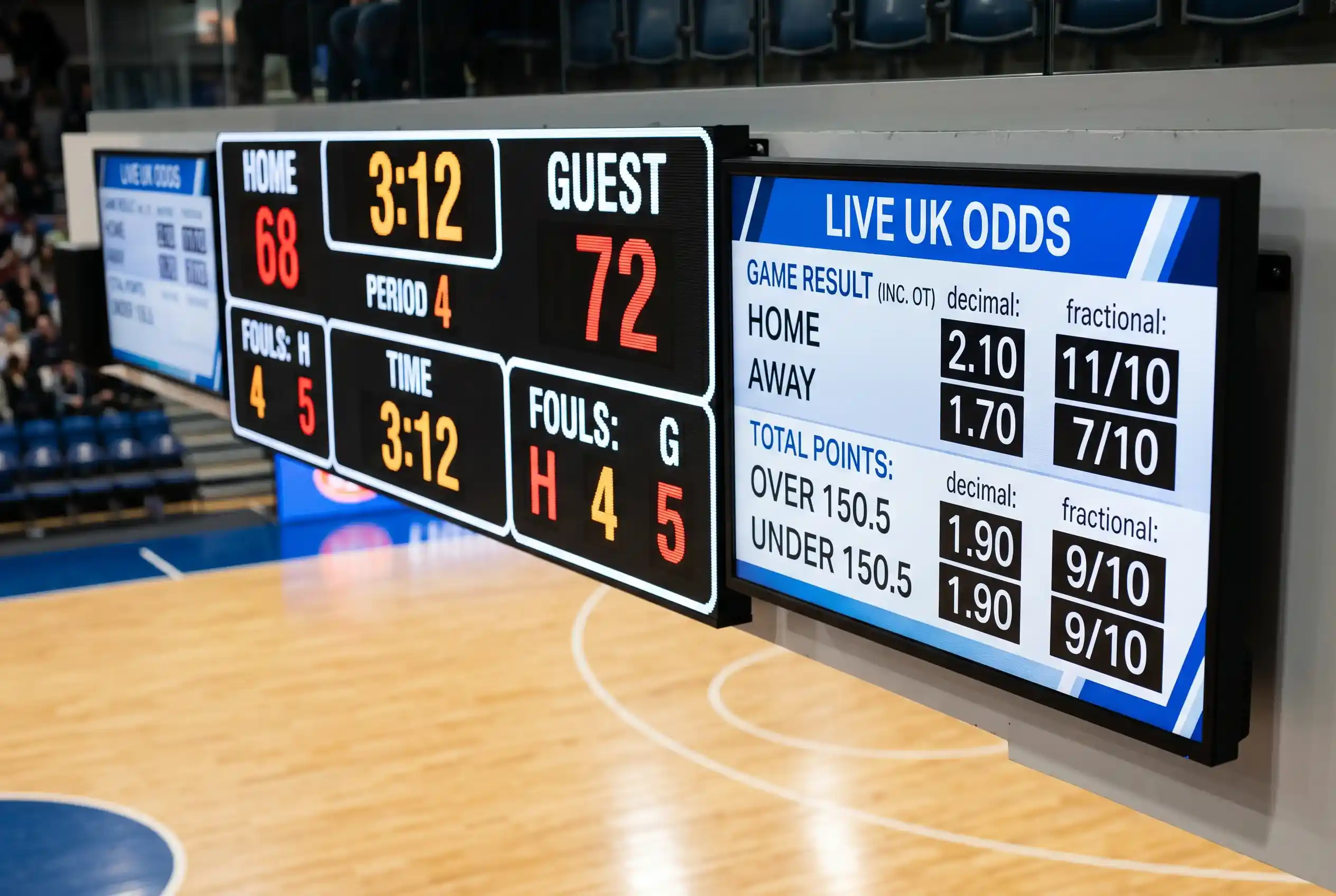
Walk into any high-street betting shop and the odds on the television screen are fractional: 5/4, 11/8, 2/1. That is the format British gambling culture grew up with, rooted in horse racing and football. Log into the same operator’s app and switch to the NBA section, and you might find decimal as the default — or fractional, depending on the platform’s design choices. Both formats encode exactly the same information; the difference is purely presentational.
Fractional odds express profit relative to stake. Odds of 3/1 mean three pounds profit for every one pound staked. Odds of 1/4 mean twenty-five pence profit per pound staked. The total return is stake plus profit, so 3/1 returns four pounds on a one-pound bet. Simple enough for round numbers, but fractional odds become awkward with basketball’s tight markets. An NBA moneyline at 10/11 requires mental gymnastics that decimal handles instantly.
Decimal odds show total return per unit staked. Odds of 1.91 mean a one-pound stake returns £1.91 — that is your original pound plus 91p profit. To calculate profit, subtract one. To calculate total return on any stake, multiply stake by the decimal number. A twenty-pound bet at 1.91 returns £38.20. The maths is faster, cleaner, and — for basketball — much more practical.
I switched to decimal permanently in my third year of basketball analysis and have never looked back. Every piece of NBA data, every American podcast, every international betting resource uses decimal or American formats. If you are serious about basketball betting, change your account settings to decimal and stop converting.
Calculating Implied Probability From Basketball Odds
Behind every price sits a probability estimate. Decimal odds of 2.00 imply a 50% chance (1 divided by 2.00 = 0.50). Odds of 1.50 imply 66.7% (1 / 1.50 = 0.667). Odds of 3.00 imply 33.3%. The formula is universal: implied probability = 1 / decimal odds.
This calculation is the single most important skill in betting, and I am constantly surprised by how many experienced punters skip it. When you see the Bucks at 1.40 and the Hornets at 3.20, you are not just seeing “the Bucks are favourites.” You are seeing the bookmaker’s estimate that the Bucks have a 71.4% chance of winning and the Hornets have a 31.3% chance. Those two percentages add up to 102.7%, not 100% — and that excess is the overround, which I will cover next.
The practical application is straightforward. Before placing any bet, convert the odds to implied probability. Then ask yourself: do I believe this outcome is more likely than the implied probability suggests? If the Bucks are priced at 71.4% and your analysis says they win 78% of the time in this specific context (home game, full-strength roster, opponent on a back-to-back), the bet has positive expected value. If your number is lower than the implied probability, pass.
This is not guesswork. It is the framework that every professional bettor I know uses, and it works identically whether you are looking at NBA moneylines, EuroLeague spreads, or quarter totals.
Understanding the Overround (Bookmaker Margin)
The UK gambling industry is the third-largest in the world by total revenue, generating around $27 billion in 2025. Bookmakers earn that revenue primarily through the overround — the margin built into every set of odds. In a fair market, the implied probabilities of all outcomes would sum to exactly 100%. In a real bookmaker’s market, they sum to more.
For a two-outcome NBA moneyline (team A wins or team B wins), a typical overround is 4-6%. That means the combined implied probabilities might total 104.5%. The extra 4.5% is the bookmaker’s theoretical profit margin on the market. On a totals market (over or under), the overround is usually similar. On player props and more exotic markets, it can reach 8-10% or higher.
Knowing the overround helps you evaluate which platform offers the best value. If one operator prices an NBA game at 1.85 / 1.95 (combined implied probability: 105.3%) and another at 1.87 / 1.93 (combined: 105.2%), the second platform is marginally tighter. Over hundreds of bets, those fractions of a percentage point accumulate into real money. I check overrounds on every market I bet, and I gravitate toward operators that consistently price basketball tighter than their competitors.
Comparing Basketball Odds Across Multiple UK Platforms
Odds comparison is the lowest-effort, highest-impact habit you can develop as a basketball bettor. The same NBA game will be priced differently across platforms — sometimes by a couple of pence per pound, sometimes by significantly more. Player props show the widest variation, followed by totals, then spreads, then moneylines.
Free odds comparison websites exist that aggregate prices from major UK operators in real time. I use them before every bet and have done so for years. The process takes thirty seconds: search the game, compare prices across four or five platforms, and place the bet where the odds are best. That habit alone — with no change to your selection quality — improves long-term returns by an estimated 2-3% over placing every bet at a single operator.
For niche markets like EuroLeague props or quarter totals, comparison sites may not have full coverage. In those cases, manual comparison across two or three platforms is worthwhile when the stake is above your average. For small-stake recreational bets, the convenience of using a single platform may outweigh the price difference. Calibrate the effort to the stake. For a detailed walkthrough of how decimal and fractional formats interact with specific basketball bet types like spreads and handicaps, the beginner’s guide covers the fundamentals in a practical context.
Why do different UK bookmakers show different odds for the same NBA game?
Each bookmaker sets its own prices based on internal risk models, the volume and direction of bets received, and competitive positioning. Differences are typically small on moneylines but can be significant on player props, totals, and niche markets. Comparing odds across platforms before placing a bet is the simplest way to capture better value.
How do I convert American odds to decimal for basketball?
Positive American odds: divide by 100 and add 1. So +150 becomes 2.50 in decimal. Negative American odds: divide 100 by the absolute value and add 1. So -200 becomes 1.50. Most UK platforms display decimal or fractional by default, but American odds appear in US-focused analysis content.
Published by the Basketball Betting Markets team.