Basketball Exchange Betting Betfair: Back, Lay and Trading Guide
 Available in US
The first time I used an exchange for basketball, I accidentally laid the Celtics instead of backing them and spent the entire game sweating a bet that was the exact opposite of what I intended. It was also, by accident, the trade that taught me how powerful the lay side can be. Laying — betting against an outcome — is something no traditional bookmaker lets you do, and it opens up strategies that simply do not exist in the fixed-odds world.
Exchange betting operates on a peer-to-peer model. You are not betting against a bookmaker; you are betting against other punters. The exchange platform — Betfair being the dominant one in the UK — matches backers (who think something will happen) with layers (who think it will not). The platform takes a commission on winning bets, typically 2-5%, and offers no opinion on the odds. Prices are set purely by supply and demand. In a UK online gambling market generating GGY of £7.8 billion annually, exchanges occupy a niche but deeply engaged segment of that figure.
How Exchange Betting Works for Basketball
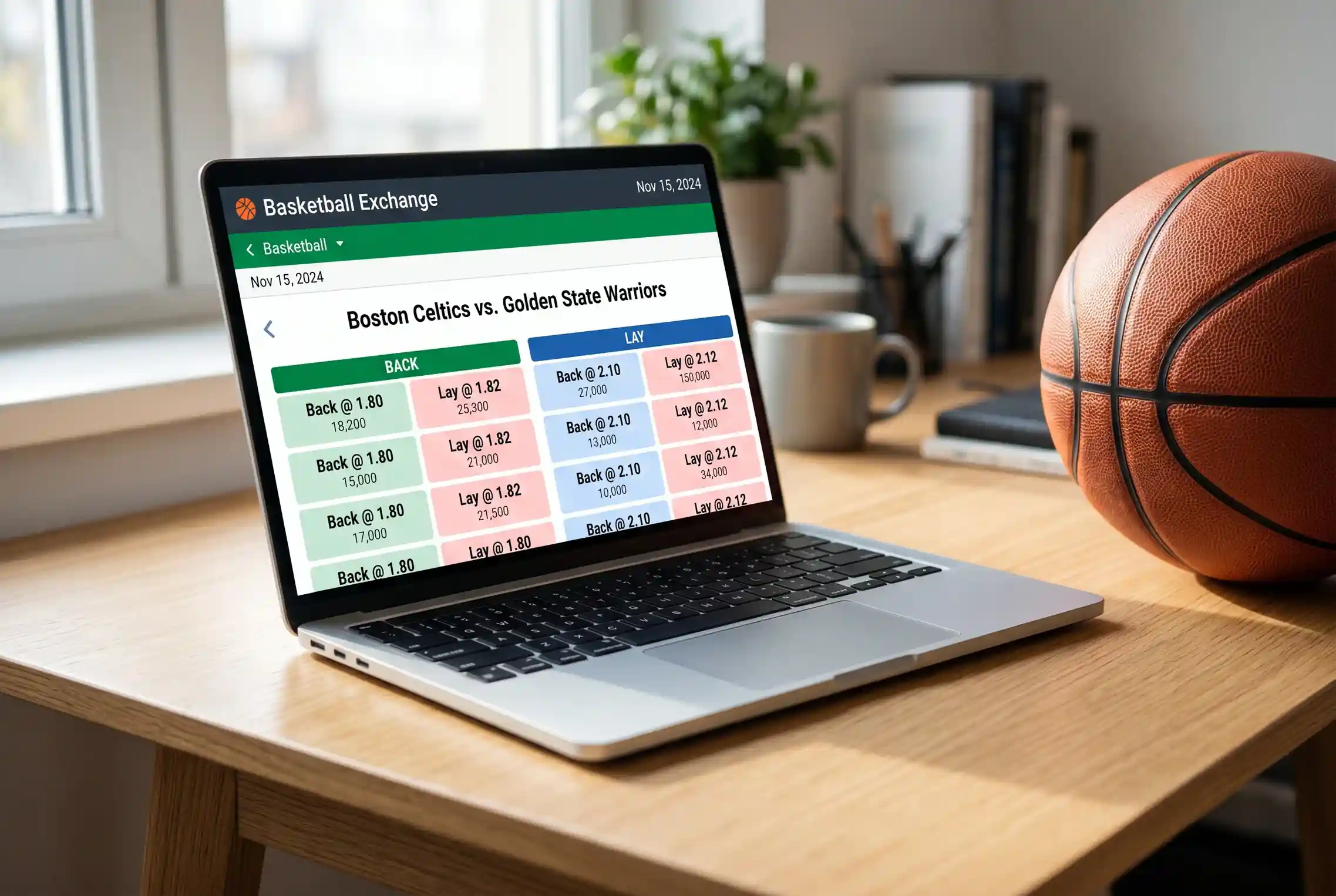
The mechanics are simpler than they look. When you log into the exchange and navigate to an NBA game, you see two columns of prices: back (blue) and lay (pink). The back price is what you receive if you bet on that outcome to happen. The lay price is what you offer if you bet against it. Between the two prices sits the spread — the exchange equivalent of the bookmaker’s overround.
Here is a concrete example. The Lakers are available to back at 2.10 and to lay at 2.14. If you back the Lakers at 2.10 with a ten-pound stake and they win, you receive £21.00 total (£11.00 profit minus commission). If you lay the Lakers at 2.14 for ten pounds, you are offering someone else the chance to back them at that price. If the Lakers lose, you collect their ten-pound stake minus commission. If the Lakers win, you pay out £11.40 (£10 x (2.14 – 1)).
The lay side introduces a concept that confuses newcomers: liability. When you back, your maximum loss is your stake. When you lay, your maximum loss is the payout you would owe if the outcome happens. On a lay at 2.14 for £10, your liability is £11.40. That money is held by the exchange until the bet settles. Understanding liability is essential before you place a single lay bet — it is the most common source of nasty surprises for exchange beginners.
Back and Lay: the Two Sides of Every Exchange Bet
Backing on an exchange feels identical to placing a bet at a bookmaker, with one critical difference: you can request a price. If the current back price on the Warriors is 1.75 and you think that is too short, you can submit a back order at 1.85 and wait for someone to match it. If the market moves in your direction before tip-off, your order fills. If it does not, the bet never gets placed and you owe nothing. That price-request mechanic turns the exchange into a live marketplace rather than a take-it-or-leave-it shop.
Laying is where the strategic depth lives. Say you believe the Nets will not win tonight but you are not sure which of their opponents has the edge. At a bookmaker, you can only back the opponent. On the exchange, you lay the Nets — which means you profit if anyone else wins, without committing to a specific alternative. In basketball, where three-team markets do not exist (unlike football’s home-draw-away), this distinction is less dramatic than in other sports, but it still matters for hedging, trading, and building positions across multiple games.
Liquidity is the practical constraint. NBA moneyline markets on Betfair carry reasonable volume for marquee games — playoffs, nationally televised fixtures, games involving the most popular franchises. Mid-week regular-season games between small-market teams may have thin order books, which means your back or lay order might not get matched, or might only partially fill. Check the available liquidity before committing to an exchange strategy for a specific game.
Exchange Odds vs Fixed-Odds Bookmaker Prices
Around 290 million online bets are placed monthly across UK platforms, and the vast majority go through fixed-odds bookmakers rather than exchanges. But exchange odds are almost always better than bookmaker odds on the back side, because the exchange has no built-in margin — only the commission on wins. A game where a bookmaker offers 1.85 / 1.85 on both sides of the moneyline might show 1.92 / 1.94 on the exchange. That difference compounds over hundreds of bets into a meaningful edge in long-term return.
The trade-off is convenience. Fixed-odds bookmakers offer guaranteed execution at the displayed price, cash-out features, bet builders, promotional offers, and a simpler interface. Exchanges require you to manage your own orders, calculate liability, and accept that some bets will not get matched. For casual bettors placing a few NBA bets per week, the bookmaker’s ease of use outweighs the exchange’s price advantage. For anyone placing fifty or more bets per month, the cumulative price benefit of the exchange becomes significant enough to justify the learning curve.
I use both. Bookmakers for props, same-game parlays, and quarter markets that do not exist on the exchange. The exchange for moneyline and totals on high-liquidity games where the price difference matters. That split lets me capture the best of both worlds without forcing every bet through a single channel.
Trading Basketball Matches: Locking In Profit Before the Buzzer
Trading is the exchange strategy that has no bookmaker equivalent. You back a team pre-game at a certain price, then lay the same team during the game at a shorter price, locking in a profit regardless of the final result. The skill is in predicting which direction the price will move — and basketball, with its continuous scoring and momentum shifts, produces more tradeable price movements per minute than almost any other sport.
A simple trade example: you back the Suns at 2.40 pre-game. In the first quarter, the Suns go on a 15-4 run. Their in-play price drops to 1.60. You lay the Suns at 1.60 for an amount that, when combined with your original back, guarantees a profit. The maths: your back at 2.40 for £20 returns £48 if the Suns win. Your lay at 1.60 for £30 means you owe £18 if the Suns win but collect £30 if they lose. Combined: Suns win = £48 – £18 – £30 = £0 profit (break even, poorly calculated example — in practice you adjust the lay stake to equalise profit across outcomes). The precise stake calculation involves dividing your back return by the lay price, and there are free calculators online that do this instantly.
Trading requires live access to the exchange during the game, fast execution, and the discipline to close your trade at a predetermined profit target rather than getting greedy. I set a target of 15-20% return on the initial stake and close the moment that level is reached. Some trades close in the first five minutes; others never reach the target and I exit at a smaller profit or a small loss. The key insight is that you are not predicting who wins — you are predicting that a price will move in a specific direction, which is a fundamentally different skill. The in-play strategy guide covers the momentum-reading techniques that underpin effective basketball trading.
Is there enough liquidity on Betfair for NBA basketball matches?
Liquidity varies significantly by game profile. Playoff fixtures and nationally televised regular-season games carry substantial volume. Mid-week games between small-market teams may have thin order books, so check matched and available amounts before placing orders. EuroLeague and college basketball liquidity is considerably lower than NBA.
How does exchange commission affect basketball betting profits?
Betfair’s standard commission is 5% on net profits per market, with loyalty discounts available for high-volume users. On a winning back bet at 2.00 with a ten-pound stake, you receive nine pounds fifty profit instead of ten. Over hundreds of bets, the commission is still significantly lower than the built-in margin at most fixed-odds bookmakers.
Prepared by the Basketball Betting Markets editorial staff.