College Basketball Betting UK: March Madness Markets and Odds
 Available in US
Every March, my inbox fills with messages from UK-based bettors who have never watched a college basketball game in their life but want to get involved because “everyone in America is going mad about it.” That instinct is not wrong — March Madness is one of the great sporting events on the planet, and the betting markets around it are enormous. But the jump from NBA betting to college basketball is steeper than most people realise, and the traps are specific to the format.
Among UK sports bettors surveyed in 2025-26, only about 3% had placed a bet on March Madness — compared to 49% who bet on the Grand National. That tells you two things: the market is tiny in the UK, which means operator coverage is thinner; and the competition among those who do bet is relatively weak, which means edges exist for anyone willing to learn the format.
NCAA Tournament Format and Betting Timeline
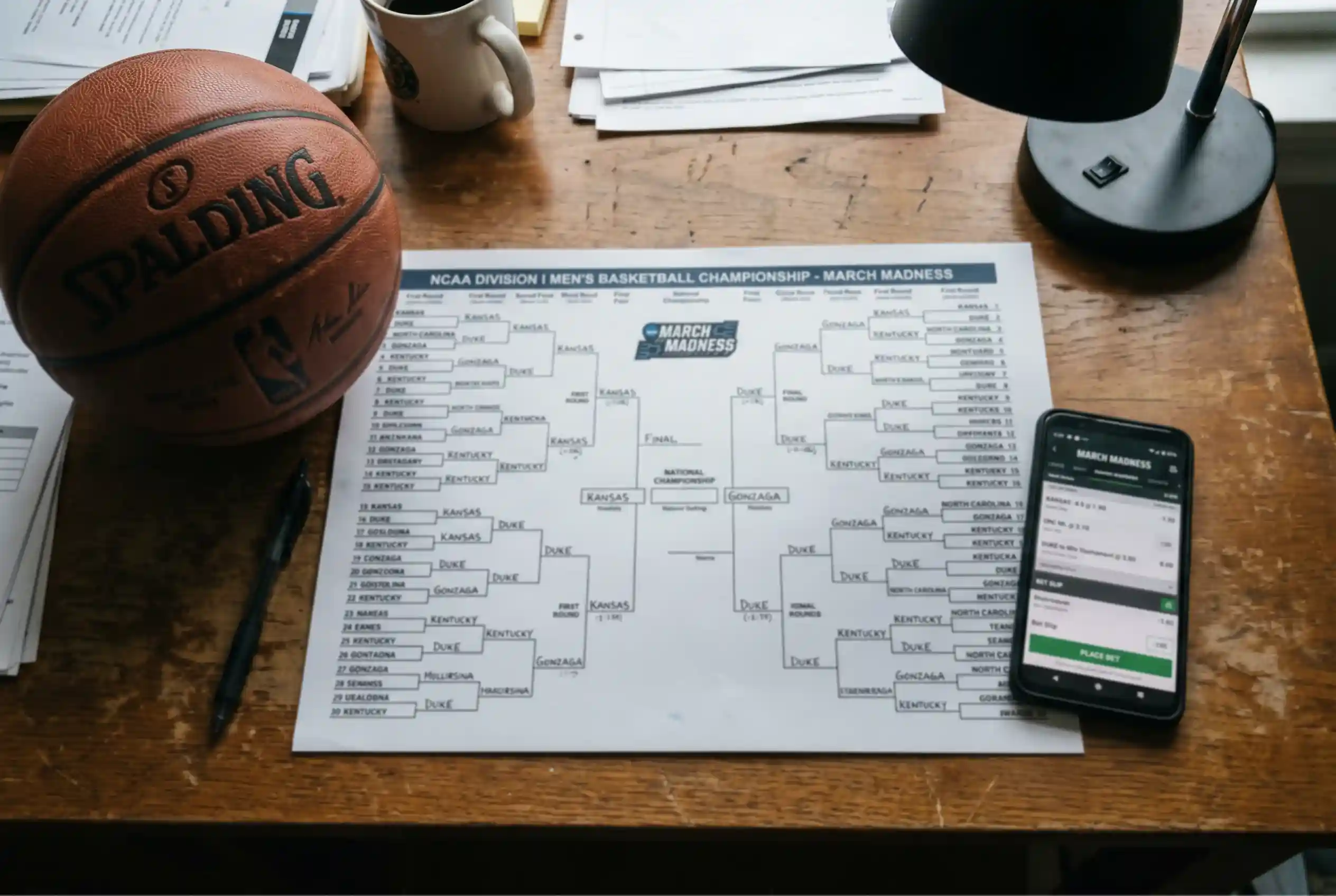
The NCAA Division I Men’s Basketball Tournament features 68 teams in a single-elimination bracket. The event runs across three weekends in March and early April, with the first round alone featuring 32 games over two days. Single elimination changes everything about how you bet. In the NBA, a best-of-seven series rewards the better team over multiple games. In March Madness, a bad shooting night, a hostile crowd, or a single questionable foul call can end a season. Upsets are not anomalies — they are structural features of the format.
The betting timeline starts in mid-February when operators post futures for the tournament winner. Selection Sunday in mid-March reveals the 68-team bracket, and game-by-game markets open almost immediately afterward. The first and second rounds (Thursday through Sunday of the first weekend) generate the highest volume of individual game bets, because 48 games are played in four days. Sweet Sixteen and Elite Eight games follow in the second weekend, with the Final Four and championship game closing the tournament.
For UK bettors, the time zone is the major practical consideration. First-round games tip off as early as 16:15 UK time and run as late as 03:00 or later. The Thursday and Friday of the first weekend are workday afternoons in the UK, which makes live betting tricky unless you have flexible hours or are willing to take a strategic sick day — something I am not officially recommending.
Markets Available to UK Punters for March Madness
Basketball generated 28% of total US betting handle in 2024, and March Madness is a significant contributor to that figure. UK operators mirror the American market to varying degrees. The largest platforms offer full game-by-game coverage for every tournament fixture: moneyline, point spread, totals, first-half lines, and sometimes player props for marquee matchups. Smaller operators may only cover the later rounds.
Tournament winner futures are available at virtually every UK bookmaker, and this is where most UK interest concentrates. The bracket structure means outright odds are long even for favourites — a top seed might be priced at 5.00 or 6.00 to win six consecutive games. That length attracts recreational bettors looking for a big payout from a small stake, which is perfectly reasonable as long as you understand the probability. A team priced at 6.00 is implied to have a roughly 17% chance of winning, and historically even the top seed wins the tournament less than 20% of the time.
Bracket-specific markets — “which team will reach the Final Four from the West Region?” — are available at some UK platforms and offer a useful middle ground between game-by-game betting and outright futures. If you believe a two-seed is undervalued but do not want to bet on them winning six games, the regional winner market lets you bet on them winning four.
How College Basketball Betting Differs From NBA Markets
The differences are fundamental, not cosmetic. College basketball features shorter games (two 20-minute halves instead of four 12-minute quarters), a wider three-point line than FIBA but narrower than the NBA, a 30-second shot clock (versus 24 in the NBA), and — most importantly — vastly more teams with vastly less data. The NBA has 30 teams playing 82 games each; Division I has over 350 teams, many of which play in conferences that receive minimal scouting attention.
For betting purposes, the data gap is the central challenge. You can build a reliable statistical model for the NBA because the sample sizes are large and the data is publicly available. College basketball models must account for strength of schedule (a team that goes 25-5 in a weak conference is not the same as a team that goes 25-5 in the Big Ten), roster turnover (college players transfer at rates that make the NBA look stable), and one-and-done freshmen whose college track record is essentially zero.
Spread markets in college basketball are wider than in the NBA. A ten-point spread is common, and fifteen-point spreads appear regularly in first-round matchups between a top seed and a 16-seed. Those wide spreads create their own dynamics: the favourite might win by twenty and still not cover if the line was -22.5. My approach to March Madness spreads is conservative — I only take positions when my model disagrees with the market by more than four points, a threshold I would lower to three for NBA games.
Finding March Madness Coverage at UK Bookmakers
Not every UK operator treats March Madness the same way. The largest platforms — the ones with the deepest sports catalogues and the most active NBA coverage year-round — typically offer the fullest tournament coverage. Smaller platforms may list futures and later-round games but skip first-round matchups between mid-major teams.
My recommendation is to check coverage before Selection Sunday and register with whichever operator offers the most comprehensive first-round markets. The first round is where the edges are biggest, because 64 teams (reduced from 68 after the First Four play-in games) include dozens that the UK betting public has never heard of. A 12-seed from the Missouri Valley Conference has statistical tendencies that you can research in an afternoon — and that most of your competition will not bother to investigate.
One practical tip: create a separate bankroll allocation for March Madness. The tournament is compact (three weeks), high-variance (single elimination), and emotionally intense. Keeping it siloed from your regular NBA betting prevents a bad bracket weekend from infecting your season-long approach. I allocate 5% of my total basketball bankroll to March Madness and treat it as a standalone project with its own tracking and review. The NBA betting guide covers the rest of the season in detail for those building a year-round framework.
What time do March Madness games start in the UK?
First-round games tip off from approximately 16:15 UK time on Thursday and Friday, with the latest games finishing around 03:00 or later. Weekend rounds start slightly earlier. The Final Four and championship game typically tip off between 23:00 and 01:00 UK time.
Are there futures markets for the NCAA basketball champion at UK bookmakers?
Yes, most major UK operators offer outright tournament winner futures from mid-February onward. Prices refresh after Selection Sunday when the bracket is revealed. Regional winner markets and Final Four qualifiers are available at some platforms but not all.
Written by the editors at Basketball Betting Markets.